
India also went on an overdrive in expanding its military engagement with like-minded countries in its neighbourhood and beyond in the face of China's relentless attempts to become a regional hegemon and establish its primacy in South Asia.
The Indian economy, severely hit by the coronavirus pandemic, is projected to contract by a massive 10.3 per cent this year, the International Monetary Fund said on Tuesday. However, India is likely to bounce back with an impressive 8.8 per cent growth rate in 2021, thus regaining the position of the fastest growing emerging economy, surpassing China's projected growth rate of 8.2 per cent, the IMF said in its latest 'World Economic Outlook' report.
Xi ordered the military to think about worst-case scenarios, scale up training and battle preparedness, promptly and effectively deal with all sorts of complex situations and resolutely safeguard national sovereignty, security and development interests, state-run Xinhua news agency reported, without mentioning any specific issues that posed a threat to the country.

Giving final touches to its most ambitious plan to build a wide network of new silk roads on land and seas to enhance global connectivity, China has invited India to join President Xi Jinping's pet project that would revive the ancient trade route and benefit the region.

With the search for missing Malaysian plane turning to India's neighbourhood, China has sought permission for sending its four warships into the Indian waters, causing a major dilemma for the authorities.

On Tuesday, Pompeo and Esper will hold the 2+2 talks with External Affairs Minister S Jaishankar and Defence Minister Rajnath Singh, covering the entire expanse of defence and security ties as well as key regional and global issues.
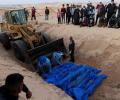
India's voting pattern in the United Nations with regard to the Israel-Palestine conflict is lately marked by a calibrated distancing from Israel, observes Ambassador M K Bhadrakumar.

'With any luck and a certain amount of rationality, we should be able to survive,' historian Antony Beevor tells Rediff.com's Sanchari Bhattacharya. 'We should learn that genocides and elimination of minorities achieve nothing and only sets a nation back. If we don't learn from our mistakes, then humanity doesn't deserve a chance to survive.'

'China's excessive military aid to Pakistan is the real elephant in the room as far as Sino-Indian relations are concerned. India should be confident enough to accept a degree of closeness between China and Pakistan, since China may wish to use this link for its foray into the Muslim world.' 'But the Chinese must be realistic enough to know that as time passes, the tactic of using Pakistan as a proxy to check India will yield diminishing returns. The US tried it for 60 years but failed, so will China,' says Colonel Anil A Athale (retd).

'The "Hollandisation" of British policy may not bring the expected gains as the future may show,' says Claude Arpi.

'Xi Jinping got a dose of Modi's medicine inside the tent where he was being hosted on the banks of the Sabarmati river.' 'Modi reportedly told him, looking deep into his eyes: "This was not expected of your country. Can you tell me when the troops are withdrawing?".'

The photo published by the People's Liberation Army Air Force showing a long-range strategic bomber flying within visible range of Yushan, Taiwan's highest mountain, has caused great concern in Taiwan amid debate about whether the mainland will reunify the island by force, state-run Global Times reported.
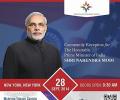
'Unlike Japan and China, the US has a long relationship with India. He is going there to fly the Indian flag in a gesture of friendship. This is a journey like none other, meant to signal that the two democracies are in a defining relationship of the 21st century.'

'If the Russian forces do capture Kyiv and set up some sort of provisional government, they might run into an insurgency, for which the geography is just right, it could prove costly for them.' 'In that event, the whole exercise could turn out to be counter-productive -- and costly in both foreign policy and domestic terms.'
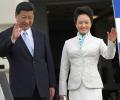
'India and China have to make concrete progress with regard to the border issue, addressing the trade deficit, and facilitating people-to-people interactions. This has to happen in the next two, three years.' China expert Tansen Sen tells Sheela Bhatt/Rediff.com how India and China can take their relations to the next level.

Among others, China is developing the strategically located Gwadar port in Balochistan, which is aimed towards having a military presence, says a Pentagon report

Here are the highlights of United States Secretary of State John Kerry's town hall at IIT-Delhi.

The exhibition of artefacts -- in physical and digital formats -- will be done on the same floor level where the leaders' meetings will take place, and they will walk through this 'cultural corridor' while moving into and out of the summit room, official sources said.
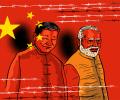
'Given the sharp increase in oil prices, a mounting problem for the 2nd and 4th largest importers like China and India -- the Qingdao meeting is likely to push for the large energy producers (Russia and the Central Asian Republics) and energy consumers (China and India) to arrive at some understanding for mutually beneficial outcomes,' notes Srikanth Kondapalli.

China's presence in the international dog house is just the kind of opportunity that his opponents must be waiting for, predicts Colonel Anil A Athale (retd).

Narendra Modi speaks to CNN's Fareed Zakaria in his first interview after becoming prime minister. The excerpts
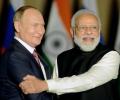
Putin made these remarks on Tuesday while speaking at the Plenary session of the 8th Eastern Economic Forum in Vladivostok, a major port city in sanctions-hit Russia's Far East region

The sources said that of the 124 positive samples, genome sequencing results of 40 were received of which XBB, including XBB.1, was found in 14 samples and BF 7.4.1 in one sample.

'If the dimensions of the strategic partnership worked out by India and the US seem like a grand alliance targeted at you-know-who, China had better realise that it has fathered it,' says B S Raghavan, a long time observer of China.

To this end, India has recently committed USD 400 million in steel to construction of the railway connecting Chabahar and Zahedan, near Afghan border, the report said.
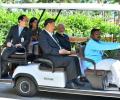
'Only when China treats India as an equal can we consider them real friends.'

China has also announced that it would hold six live-fire military drills in waters around Taiwan.

Singh, who is now the company's president for the east, central and south China division, steps into the shoes of Sanjiv Gupta.

India's national security focus has shifted from the western border to the eastern one. But our trade with China keeps rising. This trade is against our interest, because most of it comprises of Chinese imports, argues Aakar Patel.
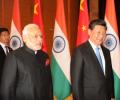
While the two sides' objectives may appear to differ, it is clear that both India and China are emphasising on the common minimum possible areas of cooperation between them, says Srikanth Kondapalli.
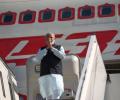
His Germany visit, which he described as a "new chapter" in bilateral relations, will begin with a meeting with Chancellor Angela Merkel at her country retreat of Schloss Meseberg.
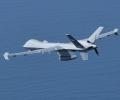
Democrat Senator Mark Warner and his Republican colleague in the Senate Dan Sullivan, during a programme in Washington asserted that the erstwhile Obama administration and the US Congress designating India as a major defence partner is a significant step forward in taking the India-US relationship to the next level.
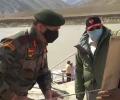
'We should not minimise the seriousness of Chinese encroachments because their perception is different.' 'Nor should we fall into the trap of accepting so-called 'buffer zones' in areas of overlapping claims. We cannot have buffer zones in our own territory,' asserts Ambassador Shyam Saran, a former foreign secretary.

All possibilities behind the disappearance of Malaysian Airlines flight MH370 are being looked into, Malaysian Prime Minister Najib Razak said in a press conference held on Saturday morning.

Narrowing of differences on competing territorial claims along the un-demarcated LAC might take weeks, if not months, of hard-nosed negotiations. Without some give and take on both sides, the impasse will be hard to resolve, observes Virendra Kapoor.
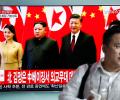
'Kim has once again shown astuteness and statesmanship by securing China's support precisely just when it matters most to him,' points out Ambassador M K Bhadrakumar.

'Does it mean that we are witnessing the end of an era?' 'Probably not, but the post-Trump trade war has certainly brought a lot of instability in China,' notes Claude Arpi.

Major General S C N Jatar, who passed into the ages on Monday night, thwarted anti-national forces at the peak of the Assam agitation. Colonel Anil A Athale (retd) salutes this officer and gentleman.

'US-Indian relations will become an important part of Trump's diplomacy,' says Global Times.
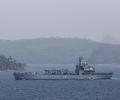
After objections raised by the defence forces, India rejected China's request for permission to allow its four warships to enter the Indian maritime zone to search for the missing Malaysian airliner.
